

Views: 0 Author: Site Editor Publish Time: 2026-08-14 Origin: Site


While HVAC systems are evaluated on overall efficiency (SEER/IEER) and reliability, the compressor is the primary driver of both metrics. It acts as the mechanical heart of any cooling system. The compressor directly dictates performance under heavy thermal stress. Understanding the internal mechanics of a scroll compressor is not just an academic exercise; it is a critical step in evaluating lifecycle costs, acoustic performance, and system downtime. Decision-makers sometimes overlook internal equipment geometry. This oversight often leads to mismatched applications or unexpected failures.
For facility managers and HVAC engineers finalizing system specifications, knowing how this technology translates physical compression into operational ROI is essential for making defensible procurement decisions. We will explore exactly how these continuous-cycle machines function. You will learn to compare them against legacy alternatives and identify the best configuration for your specific commercial installation.
Mechanical Simplicity: Scroll compressors operate using two interleaving scrolls (one stationary, one orbiting), reducing moving parts and virtually eliminating volumetric losses compared to legacy reciprocating designs.
Continuous Compression: The simultaneous suction, compression, and discharge cycle eliminates gas pulsation, significantly reducing vibration and acoustic footprint.
Liquid Tolerance: The inherent design allows the scrolls to separate slightly under stress, offering superior resistance to liquid slugging and debris.
Application Fit: While dominant in mid-tonnage commercial HVAC and residential heat pumps, specific configurations are highly effective as an industrial refrigeration scroll compressor cooling unit.
Translating physical engineering into baseline operational expectations requires a close look at internal geometry. Conventional compressors rely on a complex arrangement of pistons, cylinders, and valves. These legacy designs experience significant friction. Scroll compressors take a completely different approach. They rely on simple orbital motion to pressurize refrigerant gas.
The core mechanism consists of two spiral-shaped metal pieces called scrolls. Engineers design these parts to interleave seamlessly. One scroll remains entirely fixed. Manufacturers attach it firmly to the upper compressor body. The second scroll sits inside the first one. An electric motor drives this second scroll. It does not spin on its own axis. Instead, it orbits the fixed scroll in a continuous circular path. This orbital movement creates a series of crescent-shaped gas pockets between the two metal walls.
This unique architectural layout facilitates a seamless operational cycle. We can break this cycle down into three distinct, simultaneous stages:
Suction: Refrigerant gas enters the outer pocket of the scrolls. As the internal motor initiates the orbital sequence, the wide outer edges of the metal spirals open to draw in low-pressure vapor.
Compression: The orbiting motion forces the gas toward the center. The crescent-shaped pockets progressively shrink in volume. This rapid volume reduction steadily increases the internal gas pressure.
Discharge: High-pressure gas is continuously discharged from the center port. The vapor finally reaches the tightest inner section of the spiral. It then exits the mechanism at peak operational pressure.
Because these three stages happen simultaneously, the system behaves remarkably well under load. The compressor achieves 100% volumetric efficiency. Gas flows continuously without interruption. More importantly, the system operates entirely without traditional suction or discharge valves. Valves represent the most common failure points in older reciprocating units. They fatigue, bend, and eventually snap under stress. By eliminating valves entirely, the continuous compression design removes a massive mechanical vulnerability.
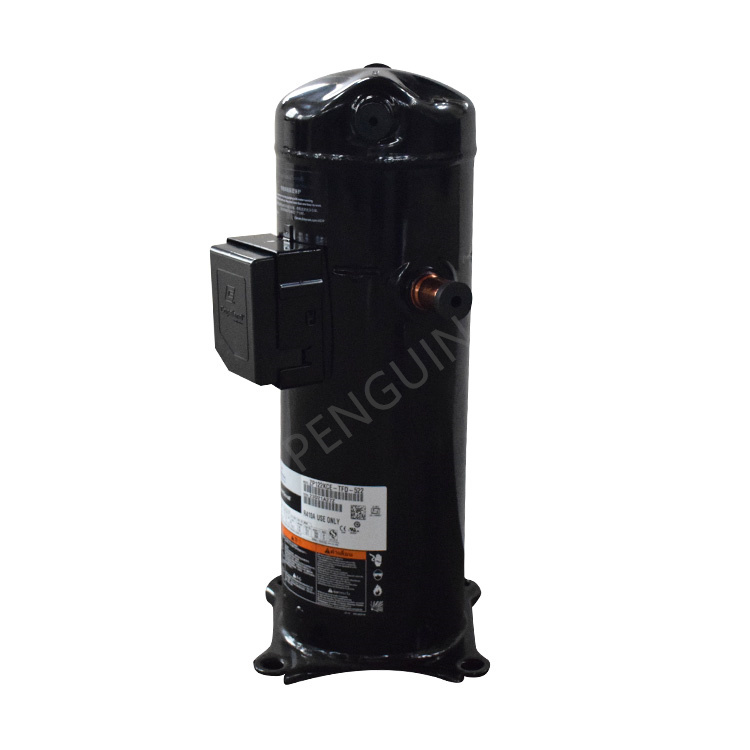
Shortlisting the correct technology requires framing the business problem against alternative options. Facility teams must evaluate how different internal geometries handle stress, load variations, and energy consumption.
Reciprocating units suffer heavily from "clearance volume" losses. In a piston-driven system, the piston cannot push entirely against the top of the cylinder. A small gap must remain to prevent mechanical collision. High-pressure gas becomes trapped in this small space. When the piston pulls back, this un-discharged gas expands back into the cylinder. This wastes enormous amounts of energy. Scroll units have zero clearance volume. The gas exits continuously out the center port.
Furthermore, they feature far fewer moving parts. You will not find pistons, wrist pins, or complex valve plates inside the casing. Fewer parts mean fewer opportunities for friction. This structural simplicity yields a flatter wear curve over a standard 15-year lifecycle. System performance remains consistent year after year.
Rotary compressors use a spinning roller inside a cylinder. They excel in very low-tonnage applications. You will frequently see them in window air conditioners or small residential mini-splits. However, they struggle to scale efficiently for larger demands. Scroll designs scale much better for mid-range commercial packaged units. They adapt perfectly to multi-compressor chillers. They offer highly stable part-load efficiencies when staged together in tandem configurations.
To simplify procurement decisions, refer to the following evaluation matrix when comparing baseline technologies.
Compressor Type | Ideal Application Range | Primary Mechanical Advantage | Primary Limitation |
|---|---|---|---|
Scroll | Mid-range commercial, heat pumps, chillers (2 to 40+ tons) | Zero clearance volume, continuous compression, very quiet | Hermetically sealed, cannot be field-repaired |
Reciprocating | Heavy industrial, specialized ultra-low temp refrigeration | Highly repairable, handles extremely high pressures well | High vibration, susceptible to valve failure |
Rotary | Low-tonnage AC, ductless mini-splits (under 2 tons) | Compact footprint, low upfront cost | Poor part-load efficiency in larger capacities |
Engineers must connect technical features directly to operational and financial success criteria. The physical design of the equipment heavily influences daily utility costs and facility comfort levels.
Continuous compression changes the financial equation for facility managers. The total lack of valve losses means higher isentropic efficiency. Isentropic efficiency measures how perfectly a system compresses a gas without losing energy to heat or friction. Higher efficiency directly lowers your monthly utility costs. The motor exerts less effort to move the same volume of refrigerant. Over a decade of operation, this reduced electrical draw yields massive savings.
The absence of piston pulsation simplifies system installation. Piston compressors hammer the gas, creating intense physical vibrations. This requires heavy vibration isolation mounting systems. The orbital motion eliminates this violent hammering effect. This inherent smoothness makes these systems ideal for sound-sensitive environments. Hospitals, multi-family high-rises, and schools benefit significantly. Facility managers can meet strict municipal noise ordinances without installing expensive acoustic dampening blankets.
Liquid slugging destroys traditional compressors instantly. Refrigerant should only enter the mechanism as a vapor. If liquid enters a piston cylinder, the incompressible fluid shatters the valves. However, modern orbital designs possess unique mechanical compliance features. They can momentarily separate axially or radially under intense physical stress.
If liquid refrigerant or small debris enters the chamber, the metal spirals push apart just enough to let the hazard pass through. They immediately snap back together afterward. This prevents catastrophic mechanical failure. We position this feature as a primary risk-mitigation factor in modern system design. It ensures your equipment survives minor operational anomalies.
Sourcing the right equipment requires evaluating modern industry-standard solutions. You must match the internal specifications directly to the external environmental demands.
The global shift toward low-GWP (Global Warming Potential) refrigerants fundamentally alters equipment selection. New refrigerants operate at higher pressures. They also generate different discharge temperatures. You require compressors engineered specifically for these distinct thermal thresholds. You cannot simply drop a new gas into an old system. You must specify modern units designed with reinforced internal bearings to handle these unique chemical properties.
Precise load matching requires advanced capacity control. Facility engineers typically evaluate two dominant modulation strategies:
Digital Modulation: This uses pulse-width modulation (PWM). A solenoid valve forces the metal spirals to separate momentarily. The motor keeps running, but compression stops. By pulsing this separation, the system achieves highly precise capacity control (from 10% to 100%).
Inverter-Driven (VFD): This changes the actual frequency of the electrical current. It slows down or speeds up the motor RPM. This provides incredibly smooth temperature control and eliminates large electrical startup spikes.
Standard HVAC models are optimized for basic air conditioning temperatures. Commercial freezing applications present an entirely different challenge. When specifying refrigeration compressors, standard configurations will overheat. Low-temperature optimization is an absolute necessity. You often need vapor injection technologies.
Vapor injection introduces mid-pressure refrigerant gas directly into the middle of the compression cycle. This immediately cools the internal mechanisms. It allows the system to reach much lower temperatures safely. Evaluating legacy industry standards provides a safe baseline. For example, analyzing the track record of copeland scroll compressors for refrigeration helps establish a reliable benchmark for expected performance. It guarantees warranty safety and ensures robust aftermarket parts availability. Integrating an industrial refrigeration scroll compressor cooling unit into a warehouse or processing plant maximizes these specialized engineering benefits.
No technology operates entirely without risk. Acknowledging operational vulnerabilities builds trust and ensures proper long-term maintenance protocols.
This technology is highly directional. The motor must spin in the correct direction. If technicians wire a 3-phase electrical unit backward, the motor spins in reverse. This causes catastrophic failure within minutes. The internal oil pump relies on forward motion. Reverse rotation starves the bearings of lubrication. Highlighting the critical necessity of installing phase monitors on 3-phase units is mandatory. A simple phase monitor instantly shuts off power if it detects incorrect electrical sequencing.
The system relies heavily on cool suction gas entering the chamber to cool the electrical motor. Low-charge scenarios present a high risk of thermal overload. If refrigerant leaks out of the system, the motor loses its primary cooling source. You must discuss and implement robust thermal protection. External sensors provide faster response times than internal overload switches. Proper low-pressure cutoff switches will save your equipment during a severe leak.
Since these mechanisms are entirely hermetically sealed, technicians cannot rebuild them in the field. Once the internal geometry fails, you must replace the entire shell. You must shift your maintenance focus from internal mechanics to external safeguards.
Inspect electrical contactors frequently for pitting or carbon buildup.
Test motor run capacitors during every preventative maintenance visit.
Manage oil levels rigorously when utilizing parallel racks.
Ensure crankcase heaters remain energized during winter months to prevent cold-start damage.
The unique internal geometry of a scroll compressor effectively solves the traditional mechanical problems of friction, valve failure, and severe vibration. By replacing violent piston strokes with smooth orbital motion, facilities gain quieter operations, superior energy efficiency, and a resilient defense against liquid slugging.
To maximize this engineering advantage, keep the following action-oriented steps in mind:
Align your specified technology exactly with your expected capacity needs and daily load variations.
Demand specific acoustic data if installing units near residential or noise-sensitive commercial spaces.
Ensure your procurement strategy accounts for phased-out refrigerant compliance schedules by demanding low-GWP compatible equipment.
Always install external electrical safeguards, such as phase monitors, to protect your investment from installation errors.
A: A commercial unit typically lasts between 12 to 15 years under normal operating conditions. However, this expectation relies heavily on proper initial installation. Ensuring tight electrical connections, utilizing phase monitors, and preventing severe liquid slugging will maximize this lifecycle.
A: No. While they handle occasional liquid slugging via radial compliance, they cannot act as liquid pumps. Attempting to pump liquid continuously will wash the essential lubricating oil out of the bearings, inevitably causing rapid mechanical failure.
A: The quiet operation stems from the continuous, non-pulsating nature of the compression cycle. Instead of pistons rapidly hammering gas and slamming metal valves shut, the orbiting spirals smoothly squeeze the gas toward the center, eliminating the majority of mechanical vibration.
A: No. The internal mechanisms sit inside a hermetically sealed, welded steel shell. They act purely as replacement items. This emphasizes the vital need for robust upstream system protection, such as pressure switches and electrical monitors.


