

Views: 0 Author: Site Editor Publish Time: 2026-09-23 Origin: Site


Designing a commercial cold room involves incredibly high stakes for your business. Sizing your compressor acts as a rigid, zero-sum game in facility engineering. Make a mistake here, and you face either catastrophic product loss or chronic, invisible energy waste.
Selecting the right refrigeration compressors requires moving far beyond generalized square-footage rules of thumb. Instead, you must calculate precise heat load metrics based on actual operational data. A simplistic sizing approach ignores critical variables, leaving your inventory completely vulnerable during peak summer temperatures.
This guide provides an evidence-based framework for evaluating, sizing, and specifying exact compressor capacities. We will help you determine the precise thermal requirements for stable, compliant cold storage operations. You will learn how to navigate complex load calculations and confidently match them to the correct hardware specifications.
Accuracy Dictates ROI: Precise heat load calculations prevent the dual threats of short-cycling (oversized) and thermal failure (undersized).
Application Determines Spec: Requirements scale non-linearly; a 5HP unit serves standard cooling, while demanding low-temp environments necessitate 25HP or 30HP two-stage systems.
Compliance & Efficiency: Modern sizing must account for regional refrigerant regulations (GWP limits) and Coefficient of Performance (COP) to accurately forecast lifecycle OpEx.
Vendor Evaluation: Shortlisting should rely on verifiable performance data at peak ambient temperatures, not just nominal capacity ratings.
Facility owners often misunderstand compressor capacity. They assume larger equipment automatically provides better cooling security. This assumption fundamentally breaks thermal dynamics. Choosing the wrong size creates severe operational and financial penalties.
Buying excessive capacity creates a dangerous mechanical loop. An oversized compressor pulls down room temperatures far too quickly. Once it hits the setpoint, the thermostat shuts it off. Minutes later, the temperature rises slightly. The compressor kicks on again. Industry professionals call this rapid sequence short-cycling.
Short-cycling destroys equipment fast. It accelerates wear on electrical contactors and motor windings. Furthermore, oversized units struggle to control humidity. Because they run for very short bursts, they never remove enough moisture from the air. This excess humidity encourages mold growth and degrades fresh produce. Ultimately, oversizing heavily bloats your initial Capital Expenditure (CapEx) while delivering inferior environmental control.
Inadequate capacity carries equally severe consequences. When a compressor lacks the necessary horsepower, it runs continuously. The system desperately tries to reach a setpoint it can never achieve. This continuous runtime generates extreme mechanical heat.
Compressor oil degrades rapidly under these extreme temperatures. Evaporator coils begin icing over, which chokes off airflow. During peak summer heatwaves, the entire system often fails completely. You face total product spoilage precisely when demand peaks. Undersizing saves money on day one but guarantees catastrophic losses later.
Smart procurement requires looking beyond the initial purchase price. Over a standard 10-year lifespan, operational expenses (OpEx) completely dwarf the initial equipment CapEx. Daily energy consumption and emergency maintenance visits drain facility budgets. Precision sizing aligns your hardware exactly to your thermal load. This alignment stabilizes energy draw, minimizes repair frequency, and protects your long-term profit margins.
You cannot buy a compressor based on room volume alone. You must calculate the total heat load. Heat load represents the total thermal energy your system must remove every 24 hours. Engineers divide this load into four distinct categories.
Heat constantly bleeds into your cold room through the physical structure. This ingress occurs across walls, the roof, and the floor. You calculate transmission load by analyzing your insulation thickness (R-value). You must also factor in the maximum external ambient temperature. Always use the highest recorded summer temperature for your specific geographical location. Ignoring extreme weather data leads to system failure during heatwaves.
Product load accounts for the heat entering the room inside your inventory. Cooling 2,000 kilograms of warm beef requires massive energy. You must calculate the specific heat of the product and establish a target pull-down time. Fresh produce complicates this calculation further. Fruits and vegetables biologically respire. They release their own heat as they age. Your calculation must account for these biological respiration rates.
Operations generate heat. Every forklift entering the room adds thermal energy. Overhead lighting generates heat. Human personnel release body heat. Infiltration load focuses on daily door openings. Every time a worker opens the main door, cold air spills out. Warm, humid air rushes in. High-traffic facilities face massive infiltration loads.
Calculations are never perfect. Real-world operations introduce variables. We recommend applying a strict 10% to 15% safety margin to your final total. This margin protects your inventory during extreme weather events or unexpected delivery volumes. However, you must avoid arbitrary padding. Adding a 40% safety margin pushes you directly into the oversizing trap.
Once you calculate your daily heat load in BTUs or kilowatts, you must convert it into an hourly compressor capacity. A common mistake is dividing the 24-hour total by 24. A cold room compressor should never run 24 hours a day. It requires time for mandatory defrost cycles. You must divide your daily load by an 18-to-20-hour runtime cycle. This ensures the unit has enough capacity to cool the room while still allowing essential downtime.
Typical Cold Room Heat Load Distribution
Load Category | Typical Percentage | Primary Contributing Factors |
|---|---|---|
Transmission Load | 20% - 30% | Panel insulation (R-value), ambient summer temperatures, sun exposure. |
Product Load | 30% - 40% | Incoming product temp, specific heat capacity, biological respiration. |
Internal Load | 5% - 10% | Forklift motors, evaporator fan motors, LED lighting, human personnel. |
Infiltration Load | 10% - 15% | Door opening frequency, air curtains, ambient humidity levels. |
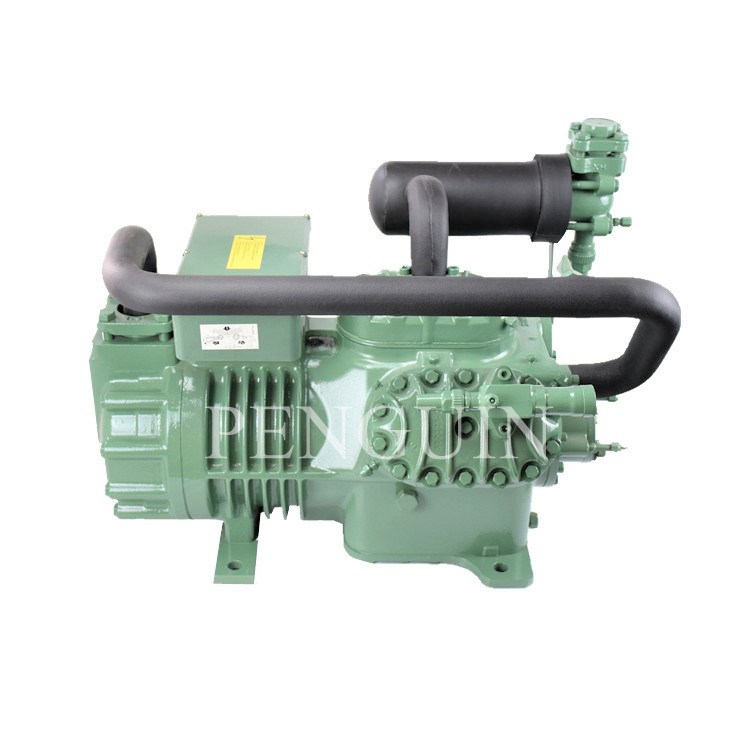
Different temperature zones demand entirely different compressor architectures. Scaling up horsepower is not enough. You must select the right internal compression technology for your specific thermal challenges.
Medium-temperature environments generally maintain temperatures between 2°C and 8°C. These rooms handle moderate door-opening frequencies and smaller inventory volumes. For these applications, we focus on the 5HP Cold Storage Refrigeration Compressor.
This unit provides highly reliable pull-down capabilities. It serves as an excellent choice for walk-in coolers, floral storage facilities, and standard restaurant food preservation. The engineering favors single-stage scroll or semi-hermetic designs. These compressors are cost-effective, easy to maintain, and highly efficient for standard commercial loads.
Deep freeze environments require aggressive temperature control. Meat processing facilities, seafood storage, and pharmaceutical cold rooms must maintain stable temperatures between -18°C and -25°C. A standard unit will fail under these pressures. Here, we focus on the 25HP Low Temperature Refrigeration Compressor.
These machines are built specifically to handle much higher compression ratios. Pushing refrigerants down to deep freeze temperatures generates intense internal heat. The system requires robust oil management to prevent viscosity breakdown. Manufacturers utilize liquid injection cooling to prevent discharge temperature faults. This technology injects a tiny amount of liquid refrigerant directly into the compression chamber, keeping internal components safe.
Industrial blast freezers represent the most hostile cooling environments. These facilities freeze massive volumes of product down to -30°C or lower in incredibly short timeframes. Single-stage compressors cannot survive this environment. For these extreme demands, we focus on the 30HP Two Stage Refrigeration Compressor.
Two-stage technology fundamentally changes the cooling dynamic. It splits the compression cycle into two separate steps. The first stage compresses gas to an intermediate pressure. The second stage pushes it to the final high pressure. This split drastically improves volumetric efficiency. It reduces internal discharge temperatures immensely. While two-stage systems carry a higher CapEx, they deliver massive energy savings under heavy load. The OpEx reduction quickly justifies the initial investment.
Once you calculate your load and identify your compressor type, you must evaluate specific hardware models. Look past the marketing brochures. Focus on tangible engineering metrics that dictate long-term viability.
Environmental regulations are rapidly changing the refrigeration industry. Governments worldwide are phasing out high-GWP (Global Warming Potential) gases. You must evaluate systems based on their adaptability to low-GWP refrigerants. Look for compatibility with CO2, R-448A, or R-449A. Purchasing equipment tied to obsolete refrigerants creates a massive liability. Future-proof your investment by demanding modern refrigerant compatibility.
Efficiency matters. COP measures how much cooling power a compressor delivers relative to the electrical energy it consumes. However, idealized lab conditions mean nothing. You must demand published COP curves from manufacturers. These curves must map performance against your facility’s specific geographical ambient extremes. A compressor might boast excellent COP at 25°C outside, but fail miserably when summer temperatures hit 42°C.
Many modern facilities experience highly fluctuating product loads. A warehouse might receive massive shipments on Monday but sit half-empty by Friday. Traditional fixed-speed compressors struggle with this variance. You should assess the ROI of variable frequency drives (VFD). Inverter technology allows the compressor to ramp its speed up or down based on real-time demand. This optimizes part-load efficiency and drastically cuts energy bills.
Hardware breaks. Your evaluation must consider repair logistics. Prioritize systems built with easily accessible service valves. Demand standard footprint dimensions to ensure replacement parts fit your racks. Furthermore, modern cold rooms benefit from telemetrics. Look for integration capabilities that connect the compressor to predictive maintenance platforms. Real-time monitoring of oil pressure and vibration signatures prevents sudden, catastrophic failures.
Excellent engineering fails without tight procurement protocols. Buying industrial refrigeration equipment requires a structured approach. You must manage vendor interactions carefully to secure reliable hardware.
Never call a vendor and ask for "a system for a 1,000 sq ft room." This amateur approach guarantees a flawed proposal. Instruct your buyers to provide vendors with exact heat load calculations. Give them your ambient temperature assumptions. Define your target pull-down times. Force vendors to quote against strict engineering data. This separates serious manufacturers from aggressive salespeople.
Supply chain realities dictate project timelines. Specialized commercial units often carry extensive lead times. You must factor these delays into your build schedule. More importantly, hardware delivery is only half the battle. Ensure your contract mandates certified commissioning. The vendor must validate real-world performance on-site. They must verify superheat, subcooling, and oil return metrics before you sign off.
Industrial warranties contain dangerous loopholes. You must scrutinize the fine print regarding warranty void conditions. Manufacturers frequently void coverage for improper electrical supply or the use of unapproved refrigerants. Ensure your facility meets all installation prerequisites. Additionally, demand strict Service Level Agreement (SLA) guarantees for replacement parts. A 10-year warranty means nothing if you have to wait six weeks for a replacement valve while your product spoils.
Sizing refrigeration compressors remains a rigid, unforgiving engineering process. It is never a guessing game. Depending on vague estimates guarantees poor performance, massive energy bills, and compromised product safety. By executing precise heat load calculations, you protect your facility against the dangers of both oversizing and undersizing.
We advise decision-makers to completely finalize their thermal data before engaging suppliers. Understand your transmission ingress, product specifics, and peak ambient challenges. Select the appropriate technology stage—whether single-stage or two-stage—based purely on your application requirements.
Do not leave your cold storage design to chance. Consult with specialized engineering teams today. Request specific technical data sheets based on your calculated load requirements. Demand rigorous proof of performance, and build a cold chain infrastructure designed for absolute reliability.
A: Square footage ignores critical variables like insulation quality, product entry temperature, daily throughput, and ambient climate, which dictate the actual thermal load.
A: Single-stage units compress refrigerant in one stroke, which is fine for medium temps. Two-stage units split the process, preventing overheating and maintaining efficiency in extreme low-temperature applications like blast freezing.
A: High external temperatures force the compressor to work harder to reject heat. Sizing must always be based on the peak summer ambient temperature of your specific location to prevent failure during heatwaves.
A: No. While a 10% safety margin on your calculated heat load is standard, arbitrarily jumping to a much larger HP causes short-cycling, which degrades humidity control and shortens equipment lifespan.


