

Views: 0 Author: Site Editor Publish Time: 2026-09-30 Origin: Site


Procuring industrial air and cooling equipment carries extremely high stakes for any facility. Incorrect sizing directly inflates your operational expenditure (OpEx) right from the start. It causes wasted energy, increased mechanical wear, and suboptimal thermal or pneumatic performance. System sizing requires a systemic calculation approach. It goes far beyond simply reading a bare-equipment specification sheet. You must actively analyze environmental variables, complex pipe runs, and required receiver capacities. Many plant managers lose thousands of dollars annually simply because they skip these foundational engineering steps.
This guide provides a robust technical evaluation framework for your upcoming procurement project. We will help you align your exact system demands with highly specific equipment capabilities. You will learn how to minimize guesswork, avoid costly oversizing traps, and mitigate implementation risks from day one.
Oversizing is a critical failure point: Specifying a unit larger than required leads to short-cycling, mechanical stress, and excessive energy consumption.
System-level thinking is mandatory: Accurate sizing requires calculating receiver capacity, pipe length, and ambient conditions, not just peak demand.
Load profiles dictate compressor type: Baseline vs. variable demands determine whether fixed-speed, variable speed (VFD), or parallel configurations are necessary.
Refrigeration requires specific architectures: High-demand cooling necessitates matching the exact load to specialized units (e.g., semi-hermetic or parallel setups) to maintain precise thermal control.
Many engineers fall into the oversizing trap. They automatically add a 20-30% safety factor to their capacity requirements. This outdated practice creates massive inefficiencies. An oversized unit rarely reaches its optimal operating temperature. It constantly loads and unloads. This rapid short-cycling drastically reduces the motor lifecycle. It also destroys partial load efficiency. You end up paying for energy you do not actually use.
Under-sizing carries equally severe risks for your facility. A unit that is too small runs at full load continuously. Constant full-load operation accelerates mechanical wear and overheating. It causes premature oil degradation. Your facility will also experience severe pressure drops at the point of use. This directly threatens production quality and machine uptime.
You must balance CapEx against long-term OpEx. The initial purchase price of equipment represents a fraction of the actual cost. Over a standard 10-year lifespan, energy consumption accounts for up to 80% of a unit’s operational expense. Accurate sizing directly protects your bottom line. It represents a strict financial imperative rather than just a basic technical guideline. Facilities that size equipment accurately often recover their capital investment in less than two years through energy savings alone.
Calculating true demand requires empirical data. You should never rely solely on existing equipment nameplates. Nameplates indicate what the old machine could do, not what your facility actually needs today. We recommend auditing your current usage utilizing precision flow meters and data loggers. Attach these instruments to your primary lines. They will reveal your exact volumetric flow rates and pressure demands over a typical production week.
You must perform a strict duty cycle analysis next. This analysis separates your continuous baseline loads from fluctuating demands. Baseline loads remain steady 24/7. Fluctuating loads vary significantly based on shift changes, seasonal production spikes, or specific batch processes. Identifying these distinct usage patterns helps you choose the right drive technology.
Environmental and ambient factors heavily dictate true volumetric efficiency. Altitude directly changes air density. Higher elevations require derating the equipment because the incoming air is thinner. Ambient temperature impacts heat rejection and air volume. Poor ventilation in your compressor room forces the machine to ingest hot air. This decreases output and forces the internal cooling system to work harder. You must adjust your baseline calculations to account for these specific site conditions.
Table 1: Data Logging vs. Nameplate Estimation
Evaluation Method | Accuracy Level | Key Benefits | Primary Drawbacks |
|---|---|---|---|
Nameplate Estimation | Low to Moderate | Fast, requires zero auditing equipment. | Replicates past sizing errors. Ignores actual current demand. |
Flow Meter Data Logging | Very High | Captures peak spikes and actual baseline usage. | Takes a full week to complete. Requires instrument installation. |
Selecting the right drive technology depends entirely on your documented load profile. You have two primary options for standard operations:
Fixed-Speed Units: Use these for steady, 24/7 baseline loads. They operate most efficiently when running constantly at 100% capacity.
Variable Speed Drive (VFD) Units: Choose VFD technology for highly fluctuating demands. The drive slows the motor down when demand drops. This prevents massive unloaded energy waste.
Industrial refrigeration demands highly specialized architectures. Standard units cannot handle extreme thermal loads. We recommend specifying a Semi-Hermetic Screw Refrigeration Compressor for heavy-duty commercial cooling. These specialized units feature a leak-proof design. The motor and compressor sit inside a single sealed housing. This design is exceptionally efficient in medium-to-low temperature applications. It prevents refrigerant leakage and uses the cold suction gas to cool the internal motor windings.
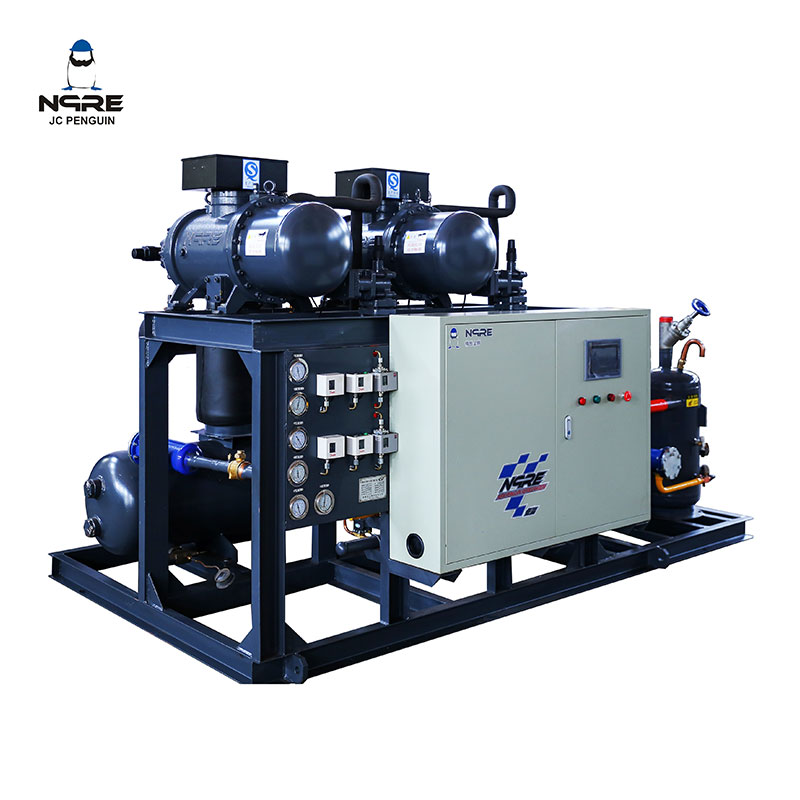
You should also evaluate scalable architecture for large-scale facilities. Implementing a Parallel Screw Refrigeration Compressor setup provides immense operational advantages. Parallel racking offers scalable, high-redundancy cooling. Sequencing multiple smaller units often outperforms relying on one massive machine. During partial-load conditions, the system simply shuts down individual compressors. This maintains peak efficiency for the running units and provides backup capability if one unit requires maintenance.
Proper system sizing encompasses much more than the primary generating unit. Storage capacity plays a vital role in system stability. You must calculate the correct receiver tank size. The industry standard rule of thumb dictates 3 to 4 gallons of storage per CFM (Cubic Feet per Minute) of output. Large receiver tanks prevent rapid cycling. They act as a buffer to stabilize system pressure during sudden demand spikes.
Piping and filtration constraints drastically alter your pressure requirements. Every elbow, valve, and pipe reduction creates friction. This friction causes pressure drops. Air dryers and inline filters also consume pressure. If your production machines require 90 PSI, generating exactly 90 PSI at the compressor will leave you starved for pressure at the end of the line. You must calculate these cumulative friction losses and oversize your pressure setpoint accordingly.
Follow these specific integration steps for cooling applications:
Calculate the total heat load of the facility or process.
Determine the necessary suction and discharge temperatures.
Select the correct Screw Compressor Condensing Unit. You must match the compressor precisely with the condenser coil and fan capacities. This ensures optimal heat rejection and maintains system equilibrium.
Evaluate the ambient temperature around the condenser to ensure adequate airflow.
Evaluating vendor proposals requires you to demystify technical performance curves. These charts plot flow against pressure, or cooling capacity against power input. You must locate your specific operating point on the curve. Do not just look at the maximum efficiency point. Look at how the machine performs at 60% or 70% load. This is where your equipment will likely spend most of its operational life.
We advise maintaining strict skepticism regarding maximum ratings. Manufacturers often market equipment based on theoretical ISO standard conditions. These ideal conditions assume perfect ambient temperatures, zero humidity, and sea-level altitude. You must demand data modeled at your actual operating conditions. Requesting custom performance curves based on your exact environment prevents post-installation capacity shortages.
Implementation and rollout risks often negate perfect sizing calculations. Common installation pitfalls ruin system efficiency. Inadequate ventilation starves air-cooled units of necessary airflow, causing immediate high-temperature shutdowns. Improper electrical sizing fails to accommodate high startup current spikes. You must ensure your local transformers and breakers can handle the inrush current, especially for large fixed-speed machines.
Your success criteria must follow a strict chronological checklist. You begin with a thorough load profile audit. Next, you select the specific drive architecture. Finally, you complete the system integration mapping. Following this exact sequence prevents costly backtracking.
You need a rigid vendor evaluation checklist before requesting any quotes. Demand certified engineering data from every supplier. For air systems, request verified CAGI (Compressed Air and Gas Institute) data sheets. For refrigeration, demand specific SEER (Seasonal Energy Efficiency Ratio) or COP (Coefficient of Performance) ratings at your exact operating conditions. These standardized documents strip away marketing claims and allow direct unit-to-unit comparisons.
Objective data logging guarantees successful procurement. We strongly encourage you to conduct a monitored system audit for at least one full production week. Deploying properly sized screw compressors is a financial necessity, not just an engineering task. Do not make a final purchase order based on assumptions or outdated legacy data.
Objective data logging serves as the only reliable foundation for accurate system sizing.
Discard the outdated 20-30% safety factor to avoid the severe mechanical and financial penalties of oversizing.
Match your load profile to the right architecture, using VFDs for fluctuating demands and parallel racking for redundant cooling.
Proper sizing acts as the critical bridge between your initial capital investment and long-term operational efficiency.
Always factor in system-level variables like receiver tanks, pipe friction, and ambient site conditions before finalizing specifications.
A: Parallel configurations offer unmatched partial-load efficiency and operational redundancy. Instead of running one massive unit at 40% capacity, a parallel rack shuts down unneeded compressors completely. This step-capacity control saves significant energy. It also ensures production continues seamlessly if one specific compressor requires routine maintenance or emergency repair.
A: Ambient temperature directly alters air density and heat rejection limits. Hotter intake air is less dense, which forces the machine to work harder to compress the same mass of air. High ambient temperatures also restrict the condenser's ability to reject heat. You must derate your equipment's capacity calculations to accommodate these environmental extremes.


