

Views: 0 Author: Site Editor Publish Time: 2026-07-24 Origin: Site


Industrial cooling systems rely heavily on robust machinery to maintain exact temperatures. Selecting the wrong compressor architecture leads to excessive energy consumption, premature mechanical failure, and compromised thermal stability. Buyers face critical choices at the decision stage. You must move past basic working principles. You need to evaluate specific design variations against load profiles and maintenance capabilities. This guide provides an objective breakdown of primary configurations. We explore application-specific matching and technical evaluation criteria. You will gain the exact knowledge needed to finalize your procurement shortlist confidently.
The primary differentiator between piston configurations is the motor-compressor enclosure (hermetic, semi-hermetic, or open), which dictates serviceability and refrigerant leak risk.
Intermittent duty cycles are the ideal operational profile for reciprocating models; continuous 24/7 loads often favor rotary alternatives.
Selecting a specific application model (e.g., a cold room piston compressor) requires aligning stage-compression limits with required evaporating temperatures.
Maintenance realities—specifically oil management and vibration control—must be factored into facility planning before procurement.
Hermetic models feature a motor and compressor sealed entirely inside a welded steel shell. Manufacturers build these units for permanence. The design eliminates the need for mechanical seals around a drive shaft. This construction creates a completely zero-leak path for the refrigerant.
These units offer distinct advantages for specific use cases. You benefit from low upfront costs and highly compact footprints. They dominate residential and light commercial cooling sectors. However, the operational reality carries a major drawback. You cannot service these units in the field. Technicians cannot open the welded shell safely. If a valve plate fractures or a motor winding burns out, you face a catastrophic failure. The situation requires a full unit replacement. Planners must weigh this replacement risk against the initial savings.
Semi-hermetic architectures use a bolted cast-iron casing. This durable housing encloses both the electric motor and the compressor block. Unlike their fully welded counterparts, these units prioritize long-term serviceability.
They represent the undisputed industry standard for medium-to-large commercial needs. Maintenance teams can unbolt the casing to access internal components. You can perform field rebuilds easily. Technicians routinely replace valve plates, piston rings, and connecting rods. This accessibility vastly extends the operational lifespan of the equipment. If the internal motor fails, you can replace the stator without discarding the entire block. They provide an ideal balance between leak prevention and mechanical longevity.
An open type piston compressor separates the driving motor from the main compressor block. The two components connect via a belt drive or a direct-drive coupling. This separation keeps the electric motor away from the refrigerant path.
This design proves highly adaptable to varying power sources. You can power them using standard electric motors, diesel engines, or even steam turbines. They perform exceptionally well in harsh environments. Heavy industrial sites prefer them for explosive or toxic gas applications. The primary reality of this setup involves the drive shaft. The shaft must protrude from the compressor body. Therefore, it requires robust shaft seal maintenance. Routine inspections prevent refrigerant or gas leakage around the seal. When properly maintained, these units outlast almost any other configuration.
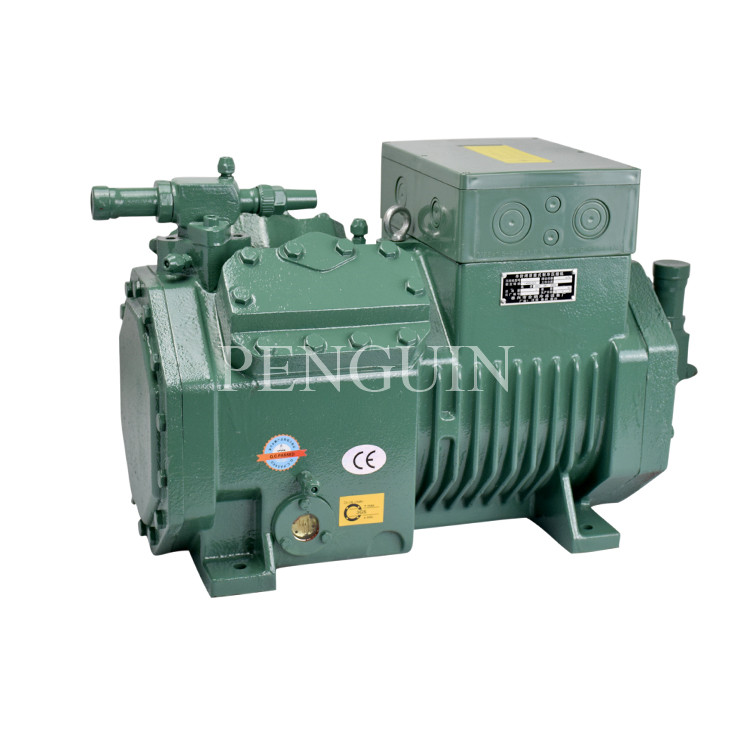
Heavy manufacturing demands rigorous performance criteria. A rugged industrial piston compressor handles aggressive environments easily. Manufacturers build them specifically for high-pressure ratios. Facilities processing natural gas, ammonia, or high-pressure air rely on these robust blocks. They often utilize multi-stage compression configurations. Multi-stage units compress gas in sequential cylinders. Technicians use intercoolers between these stages. Intercooling removes the heat generated during the first compression phase. This keeps discharge temperatures safely within operational limits.
The ultimate success metric revolves around load handling. These compressors must absorb fluctuating, heavy-duty intermittent loads. They achieve this without suffering from thermal overload. Proper staging ensures the mechanical stress remains distributed.
Supermarkets and food distribution centers require specific operational criteria. You must evaluate footprint size and acoustic output carefully. A modern commercial refrigeration piston compressor integrates smoothly into standardized rack systems. Multiple units often operate in parallel on a single steel frame. This parallel setup provides excellent redundancy and step-capacity control.
The core success metric involves reliable temperature pull-down. Display cases and food processing layouts experience constant load shifts. Customers open doors, and ambient temperatures fluctuate. The compressor must ramp up quickly to pull the temperature back to the setpoint. Rapid, reliable pull-down ensures food safety and prevents costly inventory spoilage.
Cold storage facilities operate under strict low and medium-temperature constraints. Specifying a dedicated cold room piston compressor requires evaluating the required Delta-T. Delta-T represents the temperature differential between the evaporating and condensing phases. If you need a medium temperature room above freezing, a single-stage setup works perfectly. However, deep-freeze applications require drastic temperature drops. Pushing a single-stage unit across a massive Delta-T causes oil breakdown. Therefore, low-temperature blast freezers mandate two-stage setups.
Your success metric focuses on strict thermal compliance. Perishable goods demand stable environments. The system must maintain precise temperatures while minimizing defrost cycle disruptions. Careful specification guarantees optimal cooling recovery after every defrost period.
Modern environmental standards reshape general cooling criteria. The global push away from synthetic fluorinated gases changes system designs. Upgrading your refrigeration piston compressor ensures compatibility with modern, low-GWP refrigerants. Engineers frequently deploy carbon dioxide (CO2/R744) or propane (R290) in new installations.
These natural refrigerants require specialized mechanical designs. CO2 systems operate at incredibly high transcritical pressures. Propane offers excellent thermodynamic efficiency but remains highly flammable. Compressors handling these gases require thicker casing walls and specialized safety electronics. Specifying the correct unit guarantees long-term regulatory compliance.
Mechanical longevity depends entirely on understanding the "intermittent rule." Operating piston compressors effectively requires resting periods. These reciprocating units excel when allowed to rest and cool down between cycles. A standard operational profile features a 60% to 80% duty cycle.
Pushing them to 100% continuous operation causes severe issues. Constant friction accelerates ring and valve wear exponentially. The lubricating oil overheats and loses its viscosity. Thin oil fails to protect the cylinder walls. Facility managers must size the equipment to meet peak demands while still allowing for adequate shutdown intervals.
Off-peak hours present excellent energy-saving opportunities. Modern control systems improve energy efficiency at partial loads dramatically. Mechanical capacity control uses cylinder unloading mechanisms. These unloaders physically hold the suction valves open on specific cylinders. The motor continues spinning, but those cylinders stop pumping gas. This reduces energy consumption instantly.
Variable frequency drives (VFDs) offer another excellent control method. A VFD slows down the electrical frequency supplied to the motor. The entire compressor spins slower. Combining VFDs and cylinder unloading maximizes efficiency during low-demand periods.
Proper oil management prevents catastrophic friction failures. Manufacturers utilize two distinct lubrication methods based on the unit's size and application. Splash lubrication suits smaller, low-budget setups. A dipper on the crankshaft splashes oil onto the cylinder walls. Pressure lubrication utilizes an internal oil pump. The pump forces oil through drilled channels directly to the bearings and wrist pins.
Pressure lubrication remains mandatory for heavy-duty and critical refrigeration systems. It guarantees a constant oil film regardless of RPM.
Feature | Splash Lubrication | Pressure Lubrication |
|---|---|---|
Mechanism | Crankshaft dipper throws oil upwards | Internal mechanical pump distributes oil |
Target Application | Light commercial, low-budget setups | Heavy industrial, variable-speed systems |
Low RPM Safety | Poor (Risk of oil starvation) | Excellent (Consistent oil flow) |
Cost Complexity | Very low upfront cost | Higher initial investment, requires oil filters |
Reciprocating motion creates inherent mechanical imbalances. Pistons moving up and down generate significant vibration profiles. This movement produces distinct acoustical signatures. Facility designers must plan for these realities early.
You cannot bolt these units directly to a rigid concrete floor without consequences. Specific mounting isolators absorb the kinetic energy. Spring isolators or heavy-duty rubber pads prevent vibration transmission into the building structure. Furthermore, acoustical enclosures dampen the airborne noise. Implementing these control measures impacts your total installation costs, but they prevent major structural and occupational hazards.
Procurement teams frequently debate between reciprocating and rotary architectures. You must align your mechanical choice with your facility's exact demands. Use the following logic to finalize your decision.
When to finalize a Piston Compressor:
Your application demands high-pressure requirements. Reciprocating motion compresses gases to much higher pressures than single-stage rotary units.
You experience highly variable or intermittent cooling demands. The system benefits from frequent start-stop cycles.
You face strict initial CapEx constraints. Upfront equipment costs generally fall below rotary equivalents.
You employ skilled maintenance staff. Your facility handles routine rebuilds, valve plate replacements, and oil changes internally.
When to pivot to Rotary Screw alternatives:
Your facility requires 100% continuous duty cycles. Rotary mechanisms thrive in non-stop, 24/7 operational environments.
You must meet stringent low-noise requirements. Smooth spinning rotors generate far less vibration than pounding pistons.
Your application needs massive, uninterrupted volumetric flow. Rotary units deliver large volumes of gas without pulsation.
Modern retrofits introduce chemical compatibility risks. Transitioning to new, low-GWP refrigerants often requires synthetic oils. Polyolester (POE) and Polyalkylene Glycol (PAG) oils interact differently than traditional mineral oils.
These synthetic lubricants are highly hygroscopic. They absorb moisture from the atmosphere rapidly. During installation, technicians must exercise strict moisture control. Leaving an oil container open for just a few hours ruins the oil. Moisture reacts with POE oil to form destructive acids. Installers must use deep vacuum pumps and micron gauges to ensure absolute dryness before commissioning.
High thermal loads threaten internal components constantly. When discharge temperatures climb too high, the lubricating oil begins to break down. This thermal degradation causes valve plate carbonization.
Hard carbon deposits build up on the delicate valve reeds. These deposits prevent the valves from sealing properly. Poor sealing drastically reduces cooling capacity and further increases operating temperatures. This creates a destructive feedback loop. You must mitigate this risk through strict adherence to maintenance schedules. Routine oil sampling and discharge temperature monitoring prevent catastrophic carbon buildup.
Compressors do not operate in isolation. They connect to extensive piping networks. Ensuring proper oil return represents the greatest design challenge in complex refrigeration loops.
As the system pumps gas, small amounts of oil escape into the piping. This oil must return to the crankcase continuously. Variable-load commercial setups face unique difficulties. When the system unloads and gas velocity drops, oil can become trapped in the evaporator coils or vertical pipe runs. Engineers must design proper P-traps and slope the suction lines correctly. Good piping design guarantees the crankcase never runs dry during low-load conditions.
Securing the right cooling infrastructure requires matching precise engineering capabilities to your specific environment. The ideal piston unit hinges on selecting the proper motor-compressor enclosure. You must decide whether a hermetic, semi-hermetic, or open configuration aligns best with your leak tolerance and serviceability needs. Furthermore, choosing between single and multi-stage configurations ensures you handle your required temperature differentials safely.
Before requesting a vendor quote, audit your facility rigorously. Document your maximum pressure ratios and calculate your precise cooling load in kW or BTUs. Most importantly, define your realistic duty cycle percentage. We advise consulting a technical cooling specialist to review these load calculations. Expert verification ensures your final system design delivers stable, uninterrupted performance for years to come.
A: Single-stage compressors achieve final pressure in one cylinder stroke. They work well for moderate pressure ratios and standard cooling. Two-stage compressors divide the work. Gas compresses partially in a first cylinder, cools down, and enters a second cylinder for final compression. This manages high pressure ratios safely and prevents dangerous discharge temperatures.
A: Yes, heavy industries frequently use them for toxic or flammable gases like ammonia. However, because the drive shaft protrudes through the casing, safety depends entirely on the shaft seal. You must utilize specialized mechanical seals and perform rigorous maintenance to maintain strict safety compliance and prevent leaks.
A: Rebuild timelines depend heavily on operating hours and load conditions. Typically, heavy-duty units require valve inspections every 4,000 to 8,000 hours. Major mechanical rebuilds (rings, bearings) often occur between 20,000 and 30,000 hours. Consistent oil sampling and vibration analysis provide the most accurate timeline for your specific machine.
A: Yes. Manufacturers engineer specific models for natural refrigerants. Systems using R744 (CO2) require much thicker casings and specialized valves to handle extreme transcritical pressures. Systems using R290 (Propane) demand modified electrical components to eliminate ignition sources, ensuring safe operation with flammable gas.


